Payroll & Super
Your team paid correctly and on time, with Single Touch Payroll reporting, leave and super handled every pay run, including the Payday Super rules that started on 1 July 2026.
What I take care of
- Weekly, fortnightly or monthly pay runs processed and checked before they are finalised
- New starters set up properly: TFN declaration, super fund details, pay rate and leave
- Single Touch Payroll reported to the ATO with every pay run
- Super calculated each pay run and set up to be paid on time under Payday Super
- Leave balances, payslips and final pays worked out from the information you give me
- PAYG withholding reconciled to your BAS or IAS
- STP finalisation at the end of the financial year
- Payroll reports for your accountant and your workers' compensation insurer
What I handle each pay run
Before each pay run I update anything that has changed: new starters, pay rises, hours worked, leave taken, allowances. Then I process the pay run and check it before it is finalised. Does gross pay make sense against last period? Is tax withheld correctly for each employee's TFN declaration? Has leave accrued properly? Is super calculated on the right earnings?
Once you approve it, the pay run is reported to the ATO through Single Touch Payroll, payslips go to your team, and you know exactly what to pay and when. If something looks unusual, such as an employee's hours doubling or an allowance that does not match their pay rate, I ask before it goes through, not after.
Payday Super: what changed on 1 July 2026
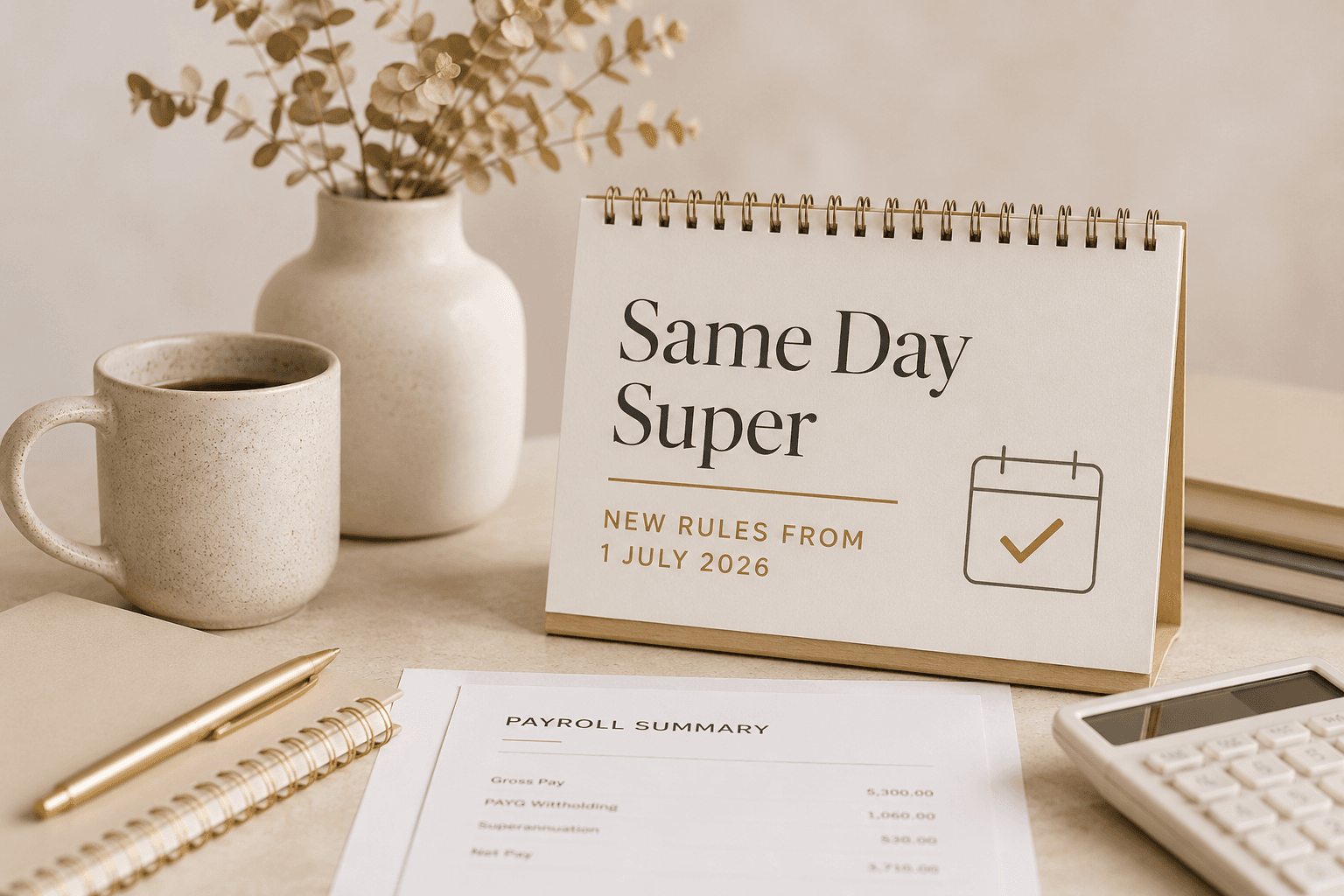
From 1 July 2026, employers pay super at the same time as wages rather than quarterly. Contributions generally need to reach each employee's super fund within seven business days of payday. For many small businesses this is the biggest payroll change in years, because super is now part of the cash flow of every pay run instead of a quarterly bill.
I set up your payroll so super is calculated with every pay run and scheduled for payment in time, and I check that contributions have actually gone through. If you are still paying super quarterly, please talk to me now. There is more detail in my article on what Payday Super means for your business.
Signs your payroll needs attention
- You are not confident your pay rates match the award or agreement that covers your staff.
- Leave balances don't look right, or employees have queried them.
- Super has been paid late, or you are not sure it has been paid for everyone.
- STP reports have failed, or you have been lodging them without really knowing what they contain.
- You have hired your first employee and don't know where to start.
- Payroll takes hours every pay day, and you worry about getting it wrong.
- Last year's STP finalisation was missed or done incorrectly.
Your first employee
Taking on your first employee means registering for PAYG withholding, setting up payroll software that reports through STP, collecting a TFN declaration and super fund details, working out the right pay rate and arranging super payments. It is all very manageable, and much easier to get right from the first pay run than to fix later. I can set it up with you.
Where payroll meets employment law
Getting pay right depends on applying the correct award or agreement, classification and conditions. I process payroll using the rates and conditions that apply to your staff, point out anything that looks inconsistent, and keep records that show how each pay was worked out.
Deciding which award applies, or how it should be interpreted for a particular employee, is an employment question rather than a bookkeeping one. The Fair Work Ombudsman is a good starting point, and for anything complex an employment adviser is the right call. I will tell you when I think you need one.
Payroll tax is a separate state tax, administered in Queensland by the Queensland Revenue Office, and generally only applies once total wages pass an annual threshold. If your wages are heading that way, I will flag it so you can raise it with your accountant.
Why a BAS agent for payroll?
PAYG withholding, STP reporting and superannuation guarantee are BAS services, so a Registered BAS Agent can advise on them and deal with the ATO about them for you. It also means your payroll and your BAS are prepared by the same person, so the figures agree.
What working with me looks like
You deal with me directly from the first call onwards.
- 01
Review your current setup
Pay rates, employee records, leave balances, super funds and past STP reports, so we start from a correct position.
- 02
Set up or tidy payroll in Xero
Pay items, leave, super and STP set up properly, with any errors we find fixed before the next pay run.
- 03
Agree the pay rhythm
When you send hours and changes, when I process, and when pay and super go out.
- 04
Every pay run
I process and check, you approve, pay goes out, STP is reported and super is scheduled.
- 05
Year end
STP finalisation done by 14 July, leave and super reconciled, and payroll reports ready for your accountant.
Questions about Payroll & Super
Can a bookkeeper help with payroll?
Yes. Processing pay runs and keeping employee records, leave and payslips up to date is standard bookkeeping work. Advising on PAYG withholding and superannuation guarantee, and dealing with the ATO about them, are BAS services, so for that side you want a Registered BAS Agent or tax agent. I am a Registered BAS Agent, so I can do both.
What is Single Touch Payroll, and do I have to use it?
Single Touch Payroll (STP) sends each employee's pay, tax withheld and super details to the ATO every time you pay them, directly from your payroll software. Almost all employers must report through STP. It replaced the old payment summaries: employees now see an income statement in myGov, and you need to finalise your STP data at the end of each financial year.
When do I need to pay super under Payday Super?
From 1 July 2026, super generally needs to reach each employee's fund within seven business days of payday, instead of by the quarterly deadline. There are limited exceptions, such as a new employee's first contribution. I set up your payroll so super is paid with each pay run.
Do you do STP finalisation at the end of the financial year?
Yes. STP finalisation is due by 14 July for most employers. I check the year's payroll figures, correct anything that needs correcting and finalise, so your employees' income statements show as tax ready in myGov.
Can you tell me which award my staff are on?
I apply the award rates and conditions that cover your staff and flag anything that looks inconsistent, but deciding which award and classification apply is an employment law question. The Fair Work Ombudsman's pay tools are a good first step, and an employment adviser can help with anything complex.
What if payroll has been done wrong in the past?
It can be fixed. I work out what went wrong and for how long, whether that is tax withheld, leave, super or pay rates, correct the payroll records and STP reporting, and tell you plainly what is owed to whom. Where super was paid late, the superannuation guarantee charge may apply, and I can help you work through it with the ATO.
What do I need to send you each pay run?
Usually just hours worked or timesheets, leave taken, and any changes such as pay rises, new starters or people leaving. We agree a cut-off each pay period so pay always goes out on time.
Read more
Talk it through with me
Send a short note about what’s going on. I usually reply within two business days to arrange a free introductory call, and I’ll tell you honestly whether I can help. You don’t need to get anything ready beforehand.
Send an enquiry →